Wednesday, June 20, 2012

Blaming American Indians as Federal Indian Education Policy

The Obama Administration's Executive Order, MOU and NCLB Waiver request for the Bureau of Indian Education  By David Beaulieu (Minnesota Chippewa Tribe-White Earth Band enrollee, former Vice President Sinte Gleska University, former Director, Office of Indian Education-US Department of Education and former President, National Indian Education Association (NIEA)
At the NIEA Legislative Summit in February at Washington DC, William Mendoza was asked about the administration’s proposal to move the Bureau of Indian Education (BIE) to the Department of Education that had been floated at consultations with tribal leaders a year earlier. Mr. Mendoza, a Rosebud tribal member, is President Obama’s appointee as Director of the White House Initiative on American Indian and Alaska Native Education established by the December 12, 2011 Executive Order 13592 -- Improving American Indian and Alaska Native Educational Opportunities and Strengthening Tribal Colleges and Universities.  
As he began to explain that the idea of moving the BIE to the Department of Education had been uniformly rejected by tribal leaders while reminding all in attendance that the government had moved the Indian Health Service without tribal consultation, Charles Rose, the former general counsel at the US Department of Education rose from his seat to stand by Mr. Mendoza to explain that the idea was his. Executive Order 13592 that Mr. Mendoza had come to explain may just be a reincarnation, albeit a “lighter” version, of the administration’s proposal to the move the BIE to the Department of Education through a negotiated MOU between the two federal agencies. 
The mission and functions of the Executive Order particularly its central function of   “strengthening the relationship between the Department of Education, which has substantial expertise and resources to help improve Indian education, and the department of the Interior and its BIE, which directly operates or provides grants to tribes to operate an extensive primary, secondary, and college level school system for AI/AN children and adults” essentially seeks transferring the leadership of the BIE to the Department of Education in order to improve Indian education. The other functions of the executive order such as ensuring AI/AN participation in the development and implementation of “key administration priorities”, coordinating programs, reporting on policy and programs, building capacity, streamlining process for entering into agreements for educational studies, developing data sources encouraging partnerships, all essentially serve the central function of the Executive Order to accomplish a “move” of the BIE to the Department of Education leadership through the development of the required Memorandum of Agreement between the two federal agencies. 
Mr. Rose had resigned by midyear 2011 to join the Drinker Biddle law firm that represents private “for profit” higher education institutions “at a time when the federal and state governments are increasing their oversight of higher education institutions and the distribution of student loan funds” according to the press release announcing his new position. Why a former Obama appointee as general counsel at the US Department of Education and at the time the new lawyer with Drinker Biddle was present at the NIEA legislative summit and came to the podium to assist Bill Mendoza is curious. Mr. Rose said in taking the blame for the proposal to move the federal agency home of the BIE to the Department of Education that the performance of BIE schools, many of them tribal controlled schools, was “so terrible that they had to propose something dramatic”.  
It should escape no one’s imagination that the same federal government that has held every state school system in the country accountable for results for 11 years with very limited or no results under the regime of the No Child Left Behind Act passed in 2001, state school systems that are no better in terms of performance with the same students as those attending BIE schools is the same federal government running the BIE.  When it comes to the federal Indian school system the federal government is both the school system involved and the agent of accountability. Shifting federal agency locations of the Federal Indian school system or by negotiating an MOU between two federal agencies to potentially increase the bureaucratic oversight and management of the Federal Indian school system will not likely change the results. When it comes to the federal government as schoolmaster there is no one left to blame for the “terrible results” but the same federal government unless the blame be given to American Indians and the statutes that relate to Indian self determination and control in the education of American Indians that have been unattended and declining as if it were a foreclosed house since NCLB was enacted through two administrations. 
The proposal to move the BIE to the Department of Education is not new as it even predates the Department of Education itself when there was but an Office of Education in the Department of Health Education and Welfare after the Elementary and Secondary Education Act (ESEA) passed in 1965. It has been proposed a number of other times since then; each time it has been uniformly rejected by tribal leaders. The proposal to transfer the BIE to the Education Department may be a lot of things but it is not a “dramatic” proposal. Certainly it’s not a panacea that will change anything except the possibility that the government’s accounting of “terrible results” will be improved.
 The MOU between Interior and Education currently in draft form pending a series of tribal consultations may well be a necessary step in terms of more effective and efficient management of the Federal school system however the executive order rationalizes the need for an MOU because evidently the BIE currently doesn’t have the “expertise and resources” to improve Indian education. What expertise and resources might that be that isn’t already in place and available all along to the BIE?  It might be advantageous to consider why another layer of accountability measures as in the stated goals of the executive order on top of the measures already in place through NCLB and a MOU between two federal agencies is unlikely to make any difference.  
The Indian Education Act is 40 years old this year with 25% of that history now under the regime of NCLB. An entire school-age generation of American Indian students has been attending school using this approach and yet this approach is somehow not blamed for the “terrible results”. What is dramatic about both the idea to move the BIE to the Department of Education and the lighter version of the same idea in the Obama Executive Order and MOU is that it is offered as a way to improve the performance of American Indian students in schools just at a time when the federal government has already managed and regulated most of the remaining vestiges of potential for genuine Indian self determination and control out of the system through the No Child Left Behind (NCLB) Act of 2001.  
Trends since NCLB was passed are very troubling to the future of self-determination and control as well as the development of quality uniquely defined education programs for American Indians that are both effective and meaningful. Despite significant policy language to the contrary in Title VII supporting the education of American Indians and Alaska Natives, the Department of Education has chosen to avoid the policy language and requirements of the statute. Rather than meeting the purposes of the Indian education act and implementing a reform agenda focused on the education of American Indian students, critical sections of statute, those dealing with a comprehensive needs assessment, the development of a comprehensive Indian education plan linked to state plans required of Title I, are simply not implemented. When it comes to the education of American Indian students NCLB envisions and requires a unique approach in each school developed with significant Indian parental involvement but it is not implemented. NCLB contrary to the actual intentions of the statute has in a sense taken the Indian out of Indian education.
Program funds intended on creating a unique Indian education presence in a school including the development and offering of curriculum related to the unique cultural heritage of students have not been supported as these funds have been increasingly utilized to support “time added” approaches such as tutoring, homework assistance, after school efforts at preparing students to take tests clearly allowable under Title I, supplanting the purposes of the formula grant program. With Title VII increasingly looking like Title I and with large sections of the required statutory provisions related to creating an Indian education presence in schools ignored, the Indian Education Act itself is at risk of being left behind.
And now an evaluative question originally posed by the Office of Management and Budget (OMB) as early as 1999 through the Bush Administration to a recent proposed study by a contractor to the Office of Indian Education, “Does the Indian Education Act formula grant program make a difference in the academic achievement of American Indian students?” It has been posed in a number of different ways, as a direct question about the formula grant program, as a question about whether culturally based education makes a difference in the academic achievement of American Indian students and now identifying effective Indian education programs funded by the formula grant using achievement as the criteria when achievement is not a direct purpose for the funds. The formula grant program has an appropriation of $104 million out of a total of $127 million dollar budget for Indian education. That represents only an approximate $300 per student. Outside of the fact that $300 per student can never make a difference in the achievement of Indian students no matter how well designed any effort may be, the purpose of the statute to create a comprehensive “presence” for Indian education throughout the school is not implemented. To consider holding the Title VII formula grant accountable for results when the appropriation is so small, the allowable programs are not directly connected to achievement and large sections of the requirements are not implemented by the federal government seems to be a set up for declaring the program a failure.
When NIEA held hearings in Indian Country in 11 different locations, a number of tribal leaders and parents reported that Indian students complained about being blamed for the schools failure to accomplish their achievement by the administrators and teachers in the school. And now the possibility that the Indian Education Act itself will be blamed for the failure of Indian students when all along it is NCLB and the federal management or more properly non-management of the Indian Education Act that should be called into question.
The No Child Left Behind Act (NCLB) requires states and the Department of the Interior’s Bureau of Indian Education (BIE) to define and determine whether schools are making adequate yearly progress (AYP) toward the goal of 100 percent academic proficiency. These are the formally defined education standards and assessments of those standards through standardized tests. NCLB recognizes that American Indian students in tribal and federal schools have unique needs and special circumstances and consequently allows tribal groups to waive all or part of the Secretary’s authorized definition of AYP and propose an alternative. Presumably this allows tribes to developed their own standards and assessments and would provide a significant opportunity toward the development of tribal education. 
The Secretary of Interior in 2005 during the Bush Administration determined that each tribal and federal operated BIE funded school would use the definition of adequate yearly progress (AYP) of the state in which the school was located. MOU’s were initially negotiated with states allowing access to the states’ assessment systems without tribes being consulted or informed of the process. Assistance from the Department of Education to assist tribes with the process of developing their own standards had been returned to the Department of Education. By 2008 only half of the MOUs were in place. There were significant complaints that the BIE had not provided assistance to tribes to develop their own education standards and assessment systems or to provide guidance on how to apply. Currently there remains reluctance to provide assistance though the need for assistance is mentioned in the draft MOU.
It is not farfetched to ask what a tribally “controlled” school is after all. If a school within a reservation was funded by the federal government and was required to follow state standards and utilize state assessment systems, I would have guessed that it is a state public school receiving federal impact aid and other sources of federal moneys to educate Indians students. The distinction is less clear ever since the Secretary of Interior ‘turned’ over tribal schools to their particular state government’s definition of what is an adequate education program for American Indians in 2005. 
There are now 37 state school systems formally applying for waivers from NCLB to have greater flexibility. These waivers devised by the Obama Administration because “Our children can’t wait for congress to fix No Child Left Behind” is contemplated for the BIE formally designated as a State Education Agency (SEA) for purposes of NCLB. A Request for Waiver is now proposed and it is now out for tribal consultation.  The Executive Order, the proposed MOU and the proposed Wavier Request fail to consider the possibility of greater flexibility consistent with existing statutes related to the education of American Indians also in NCLB. Instead all three Obama administration initiatives opt for more administration, management and uniformity of all BIE funded tribal and federal operated schools.
U.S. Secretary of Education Arne Duncan is quoted as stating in reference to the creation of waivers that "The best ideas to meet the needs of individual students are going to come from the local level. Like the first round of waiver applicants, these plans will protect children, raise the bar and give states the freedom to implement reforms that improve student achievement," There is hardly a tribal government leader, tribal school official, Indian educator or parent that would disagree with this sentiment. However, the formal structure of Indian self-determination and control that was designed to generate “the best ideas to meet the needs of individual students…from the local level” in statute has been on the decline since NCLB. If American Indian tribes were to request a waiver from NCLB instead of the BIE acting in “loco-parentis” for tribal governments, a place to start would be to request the BIE and the Department of Education at least follow the existing provisions in the NCLB statute as it pertains to education of American Indians and fully implement the law. 
The BIE request for a waiver that came after the MOU had circulated tribal consultations is an attempt not for flexibility and certainly not to fully implement the current provision of NCLB specifically related to Indian education. Instead it seeks to place all BIE funded schools, tribally operated and government operated schools under a “unified accountability system”
“At the center of the BIE’s reform approach is the creation of a unified accountability system for all BIE-funded schools. This component is critical, because the BIE — unlike the states — lacks a single, coherent accountability system. BIE is required to utilize the respective accountability systems of the 23 states in which its schools are located. For this Flexibility Request, the BIE proposes to adopt a single unified accountability system consisting of a single set of academic standards, assessments, and methodology for calculation of academic performance. Student achievement data then will be comparable across the BIE school system”.
This avoids the use of state standards by replacing them with federal standards and assessment system for all tribal and federal schools but avoids the possibility of allowable tribal government alternative standards and assessment systems.  Unified accountability systems, allowing comparable achievement data across the BIE school system, will not improve achievement nor will it do anything to improve the quality and effectiveness of education programs that could potentially accomplish achievement. For that, one would need viable local control and self-determination with educators and education leaders focused on an inspiring vision for education that connects to the real lives of Indian students in tribal communities that focuses on the needs of the tribe and its communites, and provides opportunities to engage in viable local economic and social development. 
A federal Indian education policy to support local education development that will make a difference must also be broader than what could be accomplished just in schools. It must include a coordinated and focused economic development strategy as well as a locally coordinated children’s and youth policy related to all the various efforts focused on the well being of children and youth. When tribal leaders rejected the proposal to move the BIE to the Department of Education the short answer as to why had to do with how they viewed the trustee relationship. However they understood that meant more than just education and its federal agency location but all the other various tribal programs and efforts that were focused on tribal government and local development.  Instead, what is offered is an uninspiring vision of bureaucratic uniformity as if tribes were a fiction socially, culturally and politically in terms of education governance. It is a strange thing about language and the twisting of the meaning of words to even consider the BIE waiver request as a flexibility request as it seeks no flexibility but greater bureaucratization and uniformity. 
There was a time before in the history of Indian education policy when there was a uniform set of standards and curriculum. The “Uniform Course of Study” was developed by Estelle Reel as Superintendent of Indian Schools from 1898 to 1910 and became the standardized required curriculum of all federal schools. The lack of flexibility and lack of deference to cultural and social contexts and local needs for American Indian students and tribal communities became the focus of significant criticism and national Indian education reform in the late 1920’s beginning with the Merriam Report of 1928 and should now as well for the same reasons. State governments would likely be strongly opposed to this type of federalization of their public school systems though they are looking toward the common core curriculum standards but not as a federal mandate. So ultimately Indian students and schools may be subject to the future state standards that states may adopt as well. We shall see how tribal governments and tribal leaders respond on the consultation circuit that has something new in education policy to present to tribal leaders every couple of weeks.  
Title VII of the NCLB states for the first time in statute that education is an aspect of the Federal Government’s trustee relationship, “It is the policy of the United States to fulfill the Federal Government's unique and continuing trust relationship with and responsibility to the Indian people for the education of Indian children” That may be so but the trustee relationship as defined through the Indian Self Determination and Education Assistance Act and NCLB as implemented by the BIE is essentially a contractual relationship where the government determines all the terms of the contract, provides what resources for the contract it chooses and is the sole evaluator of whether the terms of the contract have been fulfilled. 
The expression “if it looks like a duck, walks like a duck and quacks, than it must be a duck” can be applied to the Indian Education Act formula grant program and to tribally controlled education. The Indian Education Act looks like Title I and tribal controlled schools look like state public schools. Added to this is the recognition that the entire structure of Indian and tribal input into schools and education programs for American Indians is advisory in character. School officials known to rarely if ever heed advisory notions about what should be the goals, objectives and approaches for the education programs provided for American Indians have now also lost significant authority due to the mandates of NCLB. 
The real issue is to have a viable structure for tribal governance and control of education within tribal jurisdictions and for tribal governments to significantly influence the nature of the federal interest in the education of American Indians in school settings outside of tribal jurisdictions typically aligned with the intentions and purposes of federal funds for American Indians. How do we give a real voice to the intention that language and culture is not only important in its own right to be included in the education programs for American Indians but to recognize that education for all people is social and linguistic in character, that culture and language is the way through which everyone is educated. To deny the American Indians an educational environment and process that connects them socially and linguistically with what they are denies them the very means to accomplish the academic goals provided for them. How do we give a real voice to the educational needs of tribes and American Indian communities as tribal societies and communities as being important for schools and educational institutions to serve and not define for and on behalf of American Indian students and communities? How do we enable tribes to determine the purposes of education for their own tribes and communities that connect to their children and youth and to develop the type of standards that will define a tribal vision for education that schools must serve? 
What has been left of the Indian Education Act and the Indian Self determination and Education Assistance Act is an illusion or shell of control and self determination with all the control and self determination residing with the federal government and not with tribal governments, tribal school authorities or with Indian parents and communities.  Here lies the biggest danger to the development of viable self determination and control and programs that reflect the cultural heritage and respond to the needs of American Indian students, tribes and communities- that it be blamed for the very failures it has no real control over in the first place.    
Ultimately we need a new Indian Education Act that brings to life the role of tribal government and sovereignty and the federal trustee relationship for education. We can no longer bury Indian education in the lack of any real accomplishment or within titles of ESEA that are not implemented and provide only a structure of Indian parental and tribal advisory input into state public schools and education programs for American Indians which is not heeded in the first place and in the case of tribal “controlled” schools where tribes have become federal contractors of what for all intents and purposes are state public schools.  We need a new federal tribal vehicle for Indian education as well as economic and social development that produce results in the interest of children and youth, and the tribal societies and communities in which they live. The results of existing efforts in terms of achievement levels, dropout rates, the general level of failure and generally poor wellbeing of Indian children and youth beg attention to find a better way. The trustee relationship of the federal government to American Indian tribes should not solely be the federal governments to define. The trustee relationship is after all a relationship between two governments that emanates from treaties between the United States government and American Indian tribes as nation to nation as ratified by provisions the US Constitution. 
The underlying issue is that we have in a sense outgrown the statutory “pair of pants’ that the education of American Indians was suited with through the Johnson O’Malley Act of the 1934 and the initial JOM contracts with state governments that put into place the structure of federal, state and tribal governments in the education of American Indians. We have since then been developing statutes and education policy ideas within this framework and have despite the excellence of policy ideas developed to respond to the needs of American Indian students for both effective and meaningful education programs have never found a viable vehicle within that structure to implement them and to provide the type of longevity that will produce results. The federal government in the 1930s represented the interests of American Indians to the states through contracts that included conditional provisions to ensure that the states would meet the special education needs of American Indians, maintain village elementary schools in distinctly Indian villages and guarantee that Indian students would not be deprived of any resources generally available to other students. It was soon learned that the states were primarily interested in the funds and the federal government had little inclination to do anything about compelling the states to do anything unique for Indian students. Everything has been tried since to give a voice to Indian parents and tribal governments in the education of American Indian students and whatever is put into place soon defaults to little or no voice. 
What is missing and has not been tried is a structure of education governance and control for tribal governments through redefining the statutory vehicle for articulating the federal tribal relationship in education from that of a contractual relationship to a truly Nation to Nation relationship. Real tribal control lies in determining the education purposes and the education standards that will define the educational program and the contexts whereby schools will operate. The federal government must develop a more passive trustee role to allow tribal governance in education to fully emerge while protecting the tribal government interest including funding.  
Any new ideas must deal with the existence of state public school systems within the jurisdictions of tribal governments and how to represent an Indian and tribal governance voice for the education of American Indian outside of tribal jurisdictions. The ideas that have been suggested include outside of fully implementing the existing statute-the development of tribal state government compacts for education under a broad federal framework particularly in reservation areas with impact aid schools where the terms and conditions of state public education of American Indians is negotiated up front- the development and funding of tribal education departments as already authorized in two statutes as currently proposed on a trial basis in the State-Tribal Education Partnership (STEP) Pilot and tribal education  departments potentially receiving ESEA funds to all schools in a tribal jurisdiction-the creation of  tribal-state education commissions to consider Indian education issues broadly in state public schools- the development of an all Indian state funded school district in urban areas under a structure of joint tribal state governance-development of reservation wide education networks including all state public schools through tribal government agreements with each state school district-splitting the tribal school and federal school sides of the BIE, moving the SEA  functions for tribal schools to tribal governance, creating a federal tribal commission for tribally controlled education under a federal charter-develop the separate federal operated schools system as a federal national school district with a school board structure incorporating tribal representation at both the school district and LEA level-tribal governance of all existing school systems in a tribal jurisdiction or determining the contexts whereby any school system may operate within a tribal jurisdiction under a regulatory and licensing model. The list of ideas generated when considering the possibilities of tribal governments truly developing a governance function related to education can be many but then that is exactly what is necessary if we are to unleash the creative energy that would be needed to move Indian education to the next level. What is necessary is not the endorsement of any specific scheme or recommendation but the opportunity to consider and propose something brand new among tribal governments and Indian educators that will make a difference. Proposals from the Obama administration completely considered and developed within the bureaucracy and then rolled out at numerous tribal “consultations” one at a time in such a way that one never sees the entire package at once is more reminiscent of the no choice treaty days than a consultative process that could potentially develop a workable strategy and are limited in what can potentially be proposed in the first place.    
Indian education policy has been placed upon every federal education policy band wagon to come along from the original Elementary and Secondary Education Act when funds were provided the federal Indian school system from this source, when the Indian Education Act of 1972 was added to ESEA to the standards based education reform movement as represented in the Indian Nations Risk Report and the Clinton presidential executive order and now NCLB and the second Bush presidential executive order, and the third Obama presidential executive order, MOU and waiver request. At a meeting of the Indian Nations at Risk Task Force, Terrel Bell, the former Secretary of Education under President Reagan who was responsible for the “Nation at Risk” Report and at the time a co-chair of the “Indian Nations at Risk” Task Force along with William Demmert Jr reminded the Task Force members as it debated two versions of the final report that it was necessary to focus on the report that was most likely to enable Indian education to get on board with the standards based education movement. Mindful of that notion, Demmert addressed the NIEA convention in San Diego in 1990 to introduce the work of the Task Force offered a cautionary advisory in conclusion “If we are to survive as distinct cultures and people we must succeed. The challenge before us is to work with our existing institutions to see that this occurs. If our existing educational institutions will not or cannot change, and I expect them to, then they must be abandoned and new and different ones created.”
Those institutions have not and cannot change under the current system of NCLB and federal management of Indian education policy. The NCLB policy bandwagon has stopped playing music and those who jumped on board are hoping to jump off when the “train” slows down if it ever does. It’s time to construct a new statutory vehicle for tribal and Indian education based on tribal sovereignty and governance that secures a future for tribal societies, communities and people and especially tribal youth, the only ones that will become the future Indian Nations of tomorrow. 
c.David Beaulieu 6/20/2012


Monday, November 15, 2010

Wednesday, November 03, 2010

First Speakers:Restoring the Ojibwe language

Twin Cities Public Television, a subsidiary of PBS just released the following documentary about Ojibwe language revitalization efforts in the U.S. Very inspiring, and featuring several familiar faces to you. Available for free online view or free download: First Speakers: Restoring the Ojibwe Language It can be viewed or downloaded at this site http://www.tpt.org/?a=productions&id=3 A preview is provided here

Thursday, August 26, 2010

Important Speech by Diane Ravitch

The entire video and transcript can by found at http://www.nea.org/grants/40241.htm#

Wednesday, May 05, 2010

National Teacher Appreciation Week Pine Ridge High School

Robert Cook Principal at Pine Ridge High School writes today to NIEA past Presidents that this week is National Teacher Appreciation week with this note about the recent passing of teachers at Pine Ridge High School
Last week the DOE held a historic meeting at our high school on the Pine Ridge Indian Reservation. Many tribal officials, educators, parents and students attended and spoke on the needs, issues and concerns facing our students, schools and communities. The morning of the consultation our school received word that one of our long time high school teachers passed away at his home. We had our students gather during the hearing to pray and sing to honor our teacher. Today we lost another teacher, Carla Brewer, 1962 Pine Ridge High School graduate and 40 + years of service at our school passed away this morning. We gathered again in our gym to honor her service and dedication to our kids. This year we have lost 4 staff members at our school. It is extremely difficult but we must be strong for our students and each other. Thank you for your thoughts, prayers and work. This week is National Teacher Appreciation Week, Wopila Tanka to all our teachers across the country who dedicate their service, lives and passion for our students. I am proud to be a teacher and I am so proud to have worked with so many teachers and staff who became my mentors and heroes in my life, thank you to those who encouraged me that I can achieve my dreams and goals. I may not remember some of the things I learned in school but I will never forgot how you made me feel about myself, Thank you!! I know together we can make a difference in the lives of our children.
Respectfully,
Robert B. Cook,Principal
Pine Ridge High School

Tuesday, May 04, 2010

White Earth Chippewa Civil War Veterans


Chippewa civil war veterans at White Earth Reservation 1873 or 1874 (photo credit Hoard & Tenney Winona now in Minnesota Historical Society)

White Earth Family Connections to the Civil War
On June 3 of 2003 I received a message from John Lundstrom an Associate Curator at the Milwaukee Public Museum which indicated that he had learned from Dr. Nancy Lurie, at the Museum, that I might know of Captain Charles Beaulieu and the other Chippewa soldiers from White Earth who fought in Company G of the 9th Minnesota during the Civil War.

He informed me that his great great uncle had also served in the 9th Minnesota, and that he was writing a book on the Regiment for the Minnesota Historical Society. He was interested in speaking with me about his research, hoping to learn how he might find more about the Chippewa who were in the Regiment. He indicated that the Chippewa played such a gallant role in the Battle of Brice's Cross Roads, that he intended to examine it in detail in the book.

I wrote back telling him I would be very interested in helping him and informed him that I had a picture of Chippewa Civil war veterans at White Earth around 1873, that I obtained from the Minnesota Historical Society in the late 1960’s and that I believed I might have been able to identify Capt. Charles Beaulieu in the photo as there was an individual that had an officers’ sword which may be him. Charles Beaulieu was a cousin to John Beaulieu who had also been in Company G. Both were cousins to my great grandfather, Truman Beaulieu, John Beaulieu’s brother. So both John Lundstrom and I had great great uncles in the 9th Minnesota regiment. I had years prior to 2003 gathered some Information about these Chippewa that fought in the Civil War primarily because of my interest in family genealogy.

Both Charles and John had enlisted on August 16 1862 , Charles, at the age of 22, as a private and John at age 17 as a corporal. Charles became Lieutenant August 1862 and was promoted to full Captain April 20 1864 before being mustered out because of a disability May 10 1865. John was named a 2nd Lt. in Co. G and served as such for a time, but before he was formally mustered in, he was returned to the ranks for "unsoldierly conduct. John was mustered out at Fort Snelling August 24 1865

Clement Hudon dit Beaulieu who was the father of Charles Beaulieu was born 10 September 1811 Lac du Flambeau Wisconsin (Michigan Territory) and died at White Earth 14 February 1892.. He was half Chippewa and French. His father Basile Hudon dit Beaulieu is buried at La Pointe, on Madeline Island. His mother was the grand daughter of Keskemum the the noted head of the crane clan and leader at Lac du Flambeau. He was an agent of the American Fur Company, established a trading post at Crow Wing and removed in 1868 to White Earth.

He attended mission school at Mackinac and married Elizabeth Farling the daughter of a Scotch Irish missionary and an Anishenaabe woman. Clements H Beaulieu’s son Reverend Clement Hudon Beaulieu, a brother of Charles wrote that when General Sibley became the first Governor of Minnesota he commissioned some of his old fur trading associates. My father was made a Colonial of a Guard in the Northern counties of the State. As the military status of the Pioneer Guards was more or less nebulous, its real function for the greater part was social. Clement H Beaulieu was responsible for organizing the Chippewa out of St. Cloud Minnesota into a unit for the Civil War. At the end of the Civil War Captain Charles Beaulieu was an agent of the Bureau of Indian Affairs at the Bena District of the Leech lake Agency.

Charles H. Oakes who married Julia Beaulieu entered the banking business with Charles Borup who married Elizabeth Beaulieu both sisters of Clement H Beaulieu and John and Truman’s father Paul H Beaulieu my grandfather’s grandfather. The two families moved from La Pointe in Wisconsin to St. Paul, Minnesota. Oakes and Borup were important to the development of the city of St. Paul. David Oakes son of Julia and Charles fought in the Civil War and was killed in the Battle of Pittsburgh Landing in 1862.

Paul Hudon Beaulieu was born 1820 at Mackinac Michigan and died in White Earth 10 February 1897. Paul H Beaulieu led the first party of Ojibwe to settle the White Earth Reservation and is recognized as the first settler of the White Earth Reservation. He was selected as the farmer for the reservation. He was an interpreter for the Federal government.

He was an explorer that had led the Stevens' survey expedition which left from Minnesota in June 1853. The expedition was responsible for documenting the potential route of the railroad, and recording information about the flora, fauna, and the Native American tribes whose homelands were being surveyed. On November 19, 1853, the expedition arrived at Fort Vancouver on the Columbia River; eventually, it produced the most thorough report of all four surveys also undertaken for the railroad projects.

Steven’s eventually became the first Governor of Washington Territory
When the civil War broke out Stevens offered his services to the Union government and was appointed Colonel of the 79th New York Highlanders. He was commissioned Brigadier General of Volunteers in September 1861, and promoted to Major General of Volunteers less than a year later. He met his death fighting gallantly in the battle of Chantilly—the battle in which his son, Hazard, was also wounded—on September 1, 1862.

Following the Civil War John H. Beaulieu was appointed village post master at Beaulieu, Minnesota after the Civil War. I heard that the village was named for the post master.

William and Albert Fairbanks were brothers and uncles to John H Beaulieu whom along with Charles Beaulieu were all in Company G of the 9th Minnesota. William and Albert were brothers to Maria Fairbanks who married Paul H Beaulieu

William and Albert’s father was John Fairbanks was born in "The Chazy" New York July 27 1798 and died in White earth April 20 1880. He was a useful scout for the American Army during the War of 1812 and was in the battle on Lake Champlain and render efficient service during the engagement.

In 1822 he was employed by the American fur Company under John Jacob Astor until the dissolution of the company in 1835. He then entered the Northwest Fur Company and remained until 1848 when it also dissolved.

He married Mary Sayer who was the daughter of John Sayer and an Anishenabe woman. Maria's brother William was born in Mud lake Minnesota August 20 1837 and lived with his parents in Crow Wing until 1861 when he enlisted in the company of his brother Albert Fairbanks born September 23 1840.

William married Zoway McGillas August 28 1859. They had no children. After the Civil war he removed to Winnebagoshish where he engaged in trade.

Henry Hudon Beaulieu, was a Sgt in Co G and the younger brother of Paul H Beaulieu and Clement H Beaulieu. He was an Uncle of Charles and John Beaulieu. Henry was omitted from the official list of the regiment but John Lundstrom found collaborating evidence that he was indeed within Company G of the Minnesota 9th.

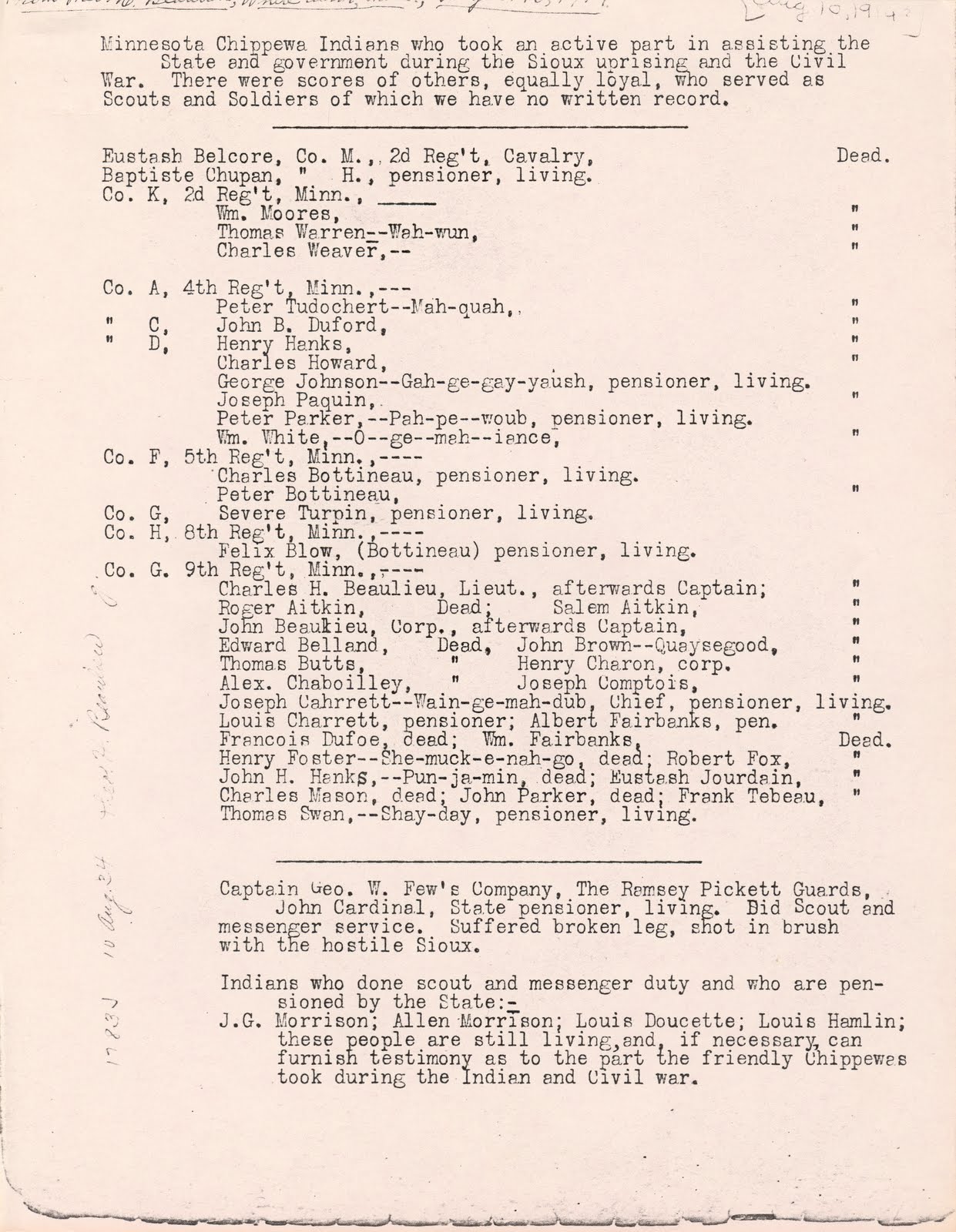
According to John Lundstrom Theodore Beaulieu in 1914 most likely using official rosters developed a list of Minnesota Chippewa Indians who took an active part in assisting the State and Government during the Sioux Uprising and the Civil War. The list was given to the Minnesota State Historical Society which has it in Beaulieu document collection.

Theodore Beaulieu’s list of Company G 9th Reg't Minn.
Charles H. Beaulieu, Lieutenant afterwards Captain
Roger Aitkin
Salem Aitkin
John Beaulieu
Edward Belland
John Brown, Quaysegood
Thomas Butts
Henry Charon
Alex. Chaboilley
Joseph Comptois
Joesph Charrett Wain ge mah dub, Chief (pensioner living 1914)
Louis Charrett
Albert Fairbanks
Francois Dufoe
William Fairbanks
Henry Foster She muck e nah go
Robert Fox
John H. Hanks Pun ja min
Eustash Jourdain
Charles Mason
John Parker
Frank Tebeau
Thomas Swan

Please see photo of List.


© 2009-2010 David Beaulieu All Rights Reserved to Big River Man News-American Indian Education

Thursday, April 29, 2010

NIEA Board Members Meet Senators Mondale and Kennedy while Developing Indian Education Act of 1972


Left to Right- Sen. Mondale, William Demmert Jr. NIEA Treasurer, Sen. Kennedy, Will Antell NIEA President, Dillon Platero NIEA First Vice President

The National Indian Education Association (NIEA) was created in 1970 following the first convocation of American Indian scholars at Princeton earlier in the year where the idea of a national organization focused on Indian education was discussed. William Demmert, Dillon Platero, and Rosemary Christensen, who incorporated the organization in Minnesota, were early organizers of NIEA had all attended the convocation. Will Antell's brother Lee had also attended the First Convocation of Indian scholars. In the fall of 1970 Will Antell was the resident Director of the American Indian graduate program in Education Administration at the University of Minnesota where his brother Lee and I were among the first group of students attending.

In the second year of the Minnesota Indian graduate program Lionel Bordeaux, Lowell Amiotte, Ken Chuck and Jim Ross, Joseph (Bud) and Herschel (Ace) Sahmaunt and Rosemary Christensen joined the Minnesota Indian graduate program. Ace Sahmaunt had been a congressional staffer during the time the Senate Subcommittee on Indian education held hearings in Washington DC in 1969 at which Rosemary Christensen and Will Antell had both testified. Ace also was a participant of the first convocation of Indian Scholars at Princeton in 1970.

Will Antell in 1970 was on loan to the graduate program as the resident Director from his position as the Director of Indian education for the State of Minnesota. The Indian graduate program at the University of Minnesota was one of four such programs supported by the Office of Economic Opportunity (OEO) including also Harvard, Penn State, and Arizona State University in that first year. We are all very grateful to Dr. Jim Wilson, Oglala from Pine Ridge, who was the Director of the Indian OEO for establishing these graduate programs. He was also the first American Indian to accomplish a Doctorate degree from ASU graduating in 1965. Another student of the Minnesota Indian graduate program in 1970 was Chuck Robertson who had along with his wife then, Gay Kingman had been students of Dr. Jim Wilson at Chadron State University in Nebraska. Both went to Washington DC where Chuck remembered assisting with putting together the graduate programs prior to coming to Minneapolis to enroll that first year. Jerry Gipp, Sandra and Dennis Fox and John Tippeconnic were among those that attended the Indian graduate program at Penn State in those early years. Rick St.Germiane was among those who attended the ASU program.

Bill Demmert was the administrator of the Kolwock Public School, Alaska when he attended the Convocation of Indian Scholars in 1970 and was by fall that year attending Harvard in the Indian Graduate program there. Dillon Platero was the Director of Rough Rock Demonstration School on the Navajo Reservation.

Initially Will Antell was asked to work on the statute as he was a personal friend of Sen. Mondale. Will could only do this part time and agreed to do it only if they hired Bill Demmert. Bill indicated that the Senators told him that the statute may not include everything that Bill wanted but it would not include anything for which he was opposed. It was from Harvard while working on his doctorate that Bill Demmert began to work with Sen. Kennedy on the development of the Indian Education Act that was to become law in 1972. The effort of working on the legislation ultimately became his thesis when debating on whether or not he could work on the legislation for the Senator or his degree at the same time, an accommodation agreeable to all was made to merge the efforts into one project and Bill began to work on the statute full time.

Among the Harvard Indian students were included Rosemary Christiansen who had been at the Upper Midwest Educational Lab in the Twin Cities, Anita Pfeiffer, who had been Assistant Director for Educational Services at Rough Rock Demonstration School and Joe Abeyta the long time and now retired Superintendant of the Santa Fe Indian School. Prior to holding hearings on the Indian education, it was Bill that recognized that Senator Kennedy’s staff hadn’t sought or had received much tribal leader support and consequently organized over a weekend the Harvard students to man a phone campaign to generate letters of support for the legislation from their tribal leaders and others. As a result a significant tribal leader voice was heard in support of the statute and it received favorable hearings and passed.

After the passage of the Statute and Bill Demmert completed his doctorate at Harvard was called upon as a special assitant to the Deputy Commissioner for Elementary and Secondary Education lead the effort at putting what was necessary into place, hire staff and all that is required to acquaint Indian people, communities and schools with the statute. Lee Antell was hired and though I was invited to consider a position in the summer of 1972, I declined and instead went to Northern Minnesota close to the White Earth Reservation where I am a member to work at Moorhead State College. The Indian Education Act programs were implemented in the US Office of Education in the Department of Health Education and Welfare (HEW) Following President Nixon’s election in 1968 and President’s new Indian Self Determination Policy of 1970, the Indian Education Act of 1972 passed. In the fall of 1972 four days prior to the November 7 1972 Presidential election of Nixon and McGovern, the American Indian Movement took over the BIA building in Washington DC.

Appropriations were provided for the Indian Education Act but President Nixon impounded the appropriations not allowing them to be applied. Bill Demmert in place in the Office of Education in HEW had a statute but no funds despite their appropriation to implement the statute. Jerry Buckanaga, Director of the White Earth Pine Point Experimental School, Secretary Treasurer of the White Earth Tribal Council and Secretary Treasurer of the Minnesota Chippewa Tribe led the effort which resulted in the Minnesota Chippewa Tribe’s suit in January 1973 against the President to force the President to implement the statute. On April 10 1973 the Coalition of Indian Controlled Schools also filed a suit to seek release of the appropriations. The suit was joined by other tribes and the federal court found against the President’s request to have the case dismissed on the grounds of separation of powers, ruling that even the President is not above following duly enacted laws of the United States. By May 1 HEW proposed rules for the implementation of the Act, on May 15th sent names forward for NACIE appointments, and committed on May 21 to have funds obligated by July 1 1973.

Will Antell had served as President for the first three years of NIEA essentially through the time period in which the Indian Education Act was being developed and then passed and then became the Chair of the National Advisory Committee on Indian Education (NACIE) and a member of the National Council on Indian Opportunity (NCIO) and Chair of its Indian Education Subcommittee. Dillon Platero became the second person to be President of NIEA

© 2009-2010 David Beaulieu All Rights Reserved to Big River Man News-American Indian Education

Wednesday, April 28, 2010

Leonard Beaulieu World War II South Pacific

This is a picture of my father Leonard Beaulieu (White Earth Chippewa) He fought in the South Pacific during World War II at Guadalcanal, the Invasion of Okinawa and the invasion and occupation of Tsingtao Northern China,


Monday, April 26, 2010

Tribal Education Departments National Assembly Statement on ESEA Reauthorization

U.S. Department of Education Tribal Consultations on The Elementary and Secondary Education Act Reauthorization April, 2010 Oklahoma City
Quinton Roman Nose

Thank you to the Department of Education for hosting this tribal consultation. We're here today because a major federal law that applies to our tribal students – the Elementary and Secondary Education Act (ESEA) – is again up for Reauthorization by Congress. In this Reauthorization we have a chance to help many or all of the 700,000 tribal elementary and secondary students nationwide in some remarkable new ways.

But first, a bit of history. In one month, the ESEA turns 45. It was enacted April 11, 1965, to help close the reported achievement gap between poorer and more affluent students. The Johnson Administration succeeded in getting Congress to authorize federal funding to states and public school districts for remedial reading and math programs for economically disadvantaged students. These are known today as the Title I programs.

Originally, the federal government's role in Title I was limited to funding. Even this was controversial, and the federal government certainly wasn't supposed to get involved in public school curricula, programs, or teaching methods. But over time and especially in the 2 most recent ESEA Reauthorizations in the last 15 years, that has changed. Today, to get Title I funds, states and public school districts have to comply with many federal directives and requirements, especially in the area of education standards.

And the ESEA has grown beyond just Title I. There are now 10 Titles with multiple programs, some of which are specific to Native Americans, like Title VII, which includes the Indian Education Act of 1972's Formula and Demonstration Grants; Impact Aid, which is in Title VIII; and, Title X, which covers the Bureau of Indian Education (BIE) funded schools. These and other ESEA and non-ESEA federal education programs like Johnson O'Malley are extremely important to tribal students, and I know that a great deal of attention to them will be paid in this Reauthorization.

Tribal Students, States, and Public Schools Need Tribal Governments in Title I

I'm going to focus on Title I and you may wonder why. It's because Title I is and always has been the biggest ESEA program. All states receive Title I funding, and well over half of the public school districts in this country receive Title I funds. Title I is administered through the U.S. Department of Education and in FY 2009, the appropriation for Title I grants was about $15 billion. This is compared to, for example, the FY 2009 appropriation for Title VII Indian Education Formula Grants – a supplemental program -- which was only $99.3 million. Because Title I funds go to improve basic core education programs, it's easy to forget that Title I is the largest federal education program serving tribal students in both the BIE-funded schools (through set-asides from the U.S. Department of Education to the U.S. Department of the Interior) and in the state public schools, which is where 92% of our tribal elementary and secondary students are.

With this level of funding, the ESEA Reauthorization will require accountability for Title I funding. So, Congress needs to know how well these massive amounts of Title I funds are serving tribal students, especially in the public schools. And the ones in the best position to make that assessment are the sovereign Tribal Governments. Over 200 tribes in 32 states have Tribal Education Departments (TEDs) or Tribal Education Agencies (TEAs). These TEDs and TEAs are available to help tribal students, and public schools, and states with the education of tribal students under the Title I standards. Right now the ESEA doesn't make those connections in Title I, but in the Reauthorization it can.

Let's talk about specifics. In the current version of Title I, states can get Title I funds if they have submitted proper plans that address academic standards, assessments, and accountability; teaching and learning support; parental involvement; and reporting. In the development of these state education plans, which are a prerequisite for Title I funds; there is no specified role for Tribes. The Tribal Education Departments National Assembly has 2 recommendations for the Reauthorization on this point:
1) Where a Tribe has a significant geographic territory and where that territory includes a high percentage of tribal students served by Title I, instead of being part of a state's Title I education plan, the TED or TEA should be allowed to develop a reservation-wide or a tribal-wide plan for Title I funds, which the Tribe should submit directly to the U.S. Department of Education. If the U.S. Education Department approves the Tribe's plan, the Tribe should get Title I funds. The Tribes should then be authorized to enter into compacts with the local education agency or public schools directly to administer the Title I funds in the local schools or administer the programs themselves.
2) In other instances where there are TEDs or TEAs located within states, the ESEA should, at a minimum, require those states to identify the TEDs and TEAs, meet with them on a quarterly basis, develop joint strategies for improving education in schools with tribal students served by Title I, and jointly report on the results of such meetings to the U.S. Education and the Interior Departments as a condition of receiving Title I funds.
These changes will connect Title I funds and programs with states and tribes. Additionally, where Tribes do get Title I funds under an approved reservation-wide or tribal-wide plan, Tribes should have the option of sub-granting the Title I funds to the public schools that serve tribal students, or, with the public school's agreement, of co-administering the Title I funds with the public schools, or even administering the Title I funds themselves. This last recommendation may sound radical, but the fact is that the BIE-funded schools have long been able to administer Title I grants directly. And the most recent ESEA Reauthorization – that's the No Child Left Behind Act – went even further to allow TEDs and TEAs to set standards in BIE-funded schools and even accredit BIE-funded schools. It's the public schools that now need these kinds of options.
Again, 92% of tribal elementary and secondary students attend state public schools, even on Indian reservations or in other tribal geographic territories. This is because historic federal laws and policies located these public schools on Indian lands. Modern federal laws like the ESEA need to reconnect these schools to tribal governments. Tribes can help with the most fundamental education improvement and accountability functions like data collection, reporting, and analysis. In particular, Tribes are in a unique position to coordinate data on tribal students that is generated by various and sometimes multiple sources, including supplemental federal education programs, public school systems, states, and BIE-funded schools. This would be something that has never happened before; right now we can only imagine accurate and current tribe-wide or state-wide or nationwide data-based reports on tribal students. But if we really had these reports, it would help agencies and Congress make data-driven decisions regarding tribal students consistent with Title I standards.
Tribes can help in other areas as well, from teacher training to research to specific local initiatives like truancy intervention, drop out prevention, and tutoring programs. There is a wide range of possibilities.

Conclusion
This Reauthorization undoubtedly will keep major roles for states and public schools in Title I. This Reauthorization also can ensure roles, or options for roles, for tribal governments in Title I. This would be a new approach that would help tribal students in this country. This isn't about Tribes taking Title I money away from the states and public schools. It's about Tribes helping to determine how Title I funds can best help tribal students meet whatever standards the reauthorized Title I sets for them. If the reports and statistics are correct, states and public schools need help from Tribes in this area. And significantly, a growing number of states are taking this direction on their own, without any federal mandate to do so, because it helps tribal students and it makes sense. Recent state education laws show that Tribes and states have found ways for Tribes as governments to have a role in public school education. They're working together on tribal language curricula and teacher certification. They're working together on public school curricula on tribal history, culture, and sovereignty. In the ESEA Reauthorization the U.S. Department of Education needs to support these efforts and facilitate more such efforts.

Sunday, April 25, 2010

Wisconsin Governor Doyle considers Bill Outlawing Indian Mascots

Wisconsin Governor Doyle Considers Bill Outlawing Indian Mascots
The Wisconsin Assembly passed a bill and Governor Doyle sign a bill that requires school districts to stop using Indian and "race-based" mascots, logos and nicknames found to promote discrimination or face monetary penalties.

There are currently more than 30 school districts with mascots or logos that could be directly affected. Some of the nicknames in question include the Redmen, Chieftans, and Warriors. Wisconsin would require the state superintendent to immediately review complaints from any school district resident. The superintendent may decide to schedule a hearing on the matter, but may decide its not necessary.
For example, a hearing would not be necessary - or could be postponed - if a school district could prove several factors, including the basis of a complaint is a depiction is of a specific, federally-recognized Indian tribe, and that tribe granted approval to the school board to use its name.

Assembly Expected To Vote On Wis. School Mascot Debate


Assembly cracks down on Indian mascots

Friday, April 23, 2010

Draft Concept Paper: A New Indian Education Act

We already have a great deal within the statute which speaks to what we want to happen with Indian education-a lot of fine words and pronouncements- but every mechanism available to implement them, which may mention American Indian involvement, relegates that involvement to an ‘advisory’ role. The advisory structure in Indian education is a problem to getting anything done. Parent advisory committees and tribal advisory input in most of ESEA is impotent and what is being asked in terms of advice is beyond the competence of these committees, even with knowledgeable staff. Assuming that what is requested could be done with perfection, the advice is none the less advisory carrying no impact or effect. This is the area for tribal government to step up to the plate in terms of authority and defining a work for a Tribal Department of Education connected to schools

The fact that these areas are a part of statute and however weak the advisory mechanisms are, it is important to remember Congress intends an Indian voice or input. It is not a great stretch to say, the current arrangement does not work indeed it’s rarely paid any attention and what Congress intends needs a different structure i.e. A tribal government voice for Indian education

Examples- Comprehensive Plan Development

Title VII Section 7114 (b) requires a description of a comprehensive program for meeting the needs of Indian children served by the local educational agency, including the language and cultural needs of the children That plan must first describe how the comprehensive program will offer programs and activities to meet the culturally related academic needs of American Indian and Alaska Native students (section 7114 (b) (1)

The statute doesn’t provide a definition of culturally related academic needs or language and cultural needs. Instead the statute provides a non exclusive list of possible activities but more importantly provides a vehicle for locally defining what the culturally related academic needs and the language and cultural needs are that requires the involvement of Indian parents. The statute requires a comprehensive local assessment and prioritization of the unique educational and culturally related academic needs of the American Indian and Alaska Native students, requires a description of how the best available talents and resources, including individuals from the Indian community will be used to meet the needs of Indian students and requires an assurance that the comprehensive program was developed in open consultation with the parents of Indian children and parents

There must also be within the comprehensive plan a description how the comprehensive plan is consistent with the State and local plans submitted under other provisions of this Act; and includes academic content and student academic achievement goals for such children, and benchmarks for attaining such goals, that are based on the challenging State academic content and student academic achievement standards adopted under Title I for all children. It must explain how Federal, State, and local programs, especially programs carried out under Title I, will meet the needs of such students; the professional development opportunities that will be provided, as needed, to ensure that teachers and other school professionals who are new to the Indian community are prepared to work with Indian children; and that all teachers who will be involved in programs assisted under this subpart have been properly trained to carry out such programs and describes how the local educational agency will periodically assess the progress of all Indian children enrolled in the schools of the local educational agency, including Indian children
who do not participate in programs assisted under this subpart, in meeting the goals described in paragraph. Lastly the plan must demonstrate how funds made available under the formula grant will be used.

Ideas for statute change
Provide that Tribal Departments of Education as a delegated authority of a tribal governing body are allowed to develop and submit the comprehensive plans required in this section of the Title for all schools, federal and tribal in their jurisdiction. Tribal departments would seek the input of Indian parents, decide what is meant by culturally related academic needs so that the provisions can be adequately addressed, be responsible to do a complete up to date comprehensive needs assessment of the actual children attending all the schools in the region. The statute requires that comprehensive plans be ‘consistent’ with state and local plans submitted (it does not say the same) that includes academic content and student academic achievement goals for (Indian) children that are “based upon” the challenging state academic content and student achievement standards adopted under Title I for all children. This is an important area as the basis for standards is the federal law which requires states to comply. Under another section, tribal governing bodies can waive the state AYP and Secretary’s version for Federal schools. It still must pass review and be accepted by a federal authority. Well worked out content and achievement standards that are “consistent” appears a possibility as well as comprehensive plans that are consistent with state and local plans. If done well the comprehensive plan could be what is called a tribal education plan of the same order as a state or local education Plan.

The next authority of a tribal department of education, dependent on the level of authority incorporated could be to either determine and/or negotiate with state school districts and the state broadly “ how Federal, State, and local programs, especially programs carried out under Title I, will meet the needs of such students; the professional development opportunities that will be provided, as needed, to ensure that teachers and other school professionals who are new to the Indian community are prepared to work with Indian children; and that all teachers who will be involved in programs assisted under this subpart have been properly trained to carry out such programs and describes how the local educational agency will periodically assess the progress of all Indian children enrolled in the schools of the local educational agency, including Indian children
who do not participate in programs assisted under this subpart, in meeting the goals described in paragraph. Lastly the plan must demonstrate how funds made available under the formula grant will be used.”

The proposal that was discussed on the phone would allow tribal departments of education to determine for all kids white and Indian which there is no current statutory possibility. What is possible is elevating a tribal governing body through a tribal department of education to do what is required for Indian children in Title VII that engages what is intended for all of ESEA.. Because there are multiple schools and school districts within most tribal jurisdictions, the proposed idea of tribal state or school district agreement might have possibility for negotiation to agree to the alignment of all ESEA federal resources available for Indian children to meet their needs within a school as a distinct concern. The standards of negotiation and framework for Tribes would as well as level of federal oversight required for states and BIE schools can be described in statute. There is a basis for something real that allows a tribal government voice in the education of Indian children that is infinitely more rigorous than what the feds stand by and allow to occur under the current arrangements. The possibility to do this doesn’t require a tribe to do it but only if the tribe wishes to do so and has the capacity to accomplish the end objective then it should be allowed. Capacity essentially means have funds and positions to do so at least to the level that local school districts and/states must have capacity. This framework makes specific something real about what is meant by education being an aspect of the trustee relationship.

There are some other areas to consider that will help back up this idea. Write in statute the necessary changes that allow tribal governments to be recognized as a local government for purposes of FERPA.

Also though it is a small program these days JOM is extremely important to the case for providing for Tribal departments of education and for the statutory concept of Tribal State Agreement for education. The point here is to not mess with the current JOM law but use it to reinforce the idea that congress also intends and allows a negotiated agreement in this case contract between a tribe and school district under a federal education program. If the scope of this type of authority as exists in JOM encompasses directly or through an agreement what is intended for Indian children in ESEA gets the point across.

Consider Impact aid also, an ESEA title also in the scope of the comprehensive plan required and one that almost exclusively involves school districts educating Indian students though it also includes non Indian students living on trust status land. The requirements here for input are about as weak as you can get but Congress still intends parental input with tribe having a say so to complain to the Secretary if there are not policies in place to allow inputs. Include these input requirements the same as intended in developing the compressive plan and programs under title and negotiated agreements. This is among the most sensitive areas but can be allowed to be included within the proper framework for negotiation. Schools district typically see this as there operational support money which it is of course but it is also required to subject to be considered in ways which support the goals of ESEA.

Sections of NCLB that pertain to the authority of tribal governing bodies to establish standards and assessment systems are important to consider what the statute intend for tribal governing bodies with regard to establishing standards and for federal assistance when it comes to this area. This is important in a tribal governing body through functioning tribal department of education with the type of support intended could make this area truly viable. It again is also not a teach to imagine that what is developed for federal schools and approved by the same Education secretary could be applied for state as indicted in the section regarding compressive plans which I believe are also required of tribal and federal schools.

NCLB sections affecting Tribal Alternative AYP

“A) DEVELOPMENT OF DEFINITION–
(i) DEFINITION– The Secretary of the Interior, in consultation with the Secretary (of Education) if the Secretary of Interior requests the consultation, using the process set out in section 1138(b) of the Education Amendments of 1978, shall define adequate yearly progress, consistent with section 1111(b), for the schools funded by the Bureau of Indian Affairs on a regional or tribal basis, as appropriate, taking into account the unique circumstances and needs of such schools and the students served by such schools.
(ii) USE OF DEFINITION– The Secretary of the Interior, consistent with clause (i), may use the definition of adequate yearly progress that the State in which the school that is funded by the Bureau is located uses consistent with section 1111(b), or in the case of schools that are located in more than one State, the Secretary of the Interior may use whichever State definition of adequate yearly progress that best meets the unique circumstances and needs of such school or schools and the students the schools serve.
(B) WAIVER– The tribal governing body or school board of a school funded by the Bureau of Indian Affairs may waive, in part or in whole, the definition of adequate yearly progress established pursuant to paragraph (A) where such definition is determined by such body or school board to be inappropriate. If such definition is waived, the tribal governing body or school board shall, within 60 days thereafter, submit to the Secretary of Interior a proposal for an alternative definition of adequate yearly progress, consistent with section 1111(b), that takes into account the unique circumstances and needs of such school or schools and the students served. The Secretary of the Interior, in consultation with the Secretary if the Secretary of Interior requests the consultation, shall approve such alternative definition unless the Secretary determines that the definition does not meet the requirements of section 1111(b), taking into account the unique circumstances and needs of such school or schools and the students served.
(C) TECHNICAL ASSISTANCE– The Secretary of Interior shall, in consultation with the Secretary (of education) if the Secretary of Interior requests the consultation, either directly or through a contract, provide technical assistance, upon request, to a tribal governing body or school board of a school funded by the Bureau of Indian Affairs that seeks to develop an alternative definition of adequate yearly progress.”

A New Indian Education Act

If you can pull together all these areas together by scope of authority and what is intended in existing statute into a permissive section of the statute for tribal departments of education that allows Tribal governments through tribal departments of education to have the authority instead of the advisory input and provide for tribal state education agreements under a federal framework requiring negotiation with certain standards and federal review which is currently required any way, you then have a new Indian education Act. It is not necessary to change the location of these sections for schools within tribal jurisdictions for those tribes which do not want to do this unless in fact we should generally change locations of certain sections of Title VII such as elevating the language about the trustee status and goals for Indian education and requirements for comprehensive plans and alignment of all federal programs to meet the needs of Indians student into the operating principals of ESEA including a statement of purposes unique to Indian education which state governments must follow. This can be done as simply by directly stating and referencing the specific sections of the Indian education Act in this section of Title I. There also needs to be an appropriation a piece of the huge Title I pie for tribes to actually do what is intended..

If we also consider and tribal departments of education apply for the possibility of utilizing schools as service centers for Indian student and families enrolled in the school which is a program possibility in I believe Title I, It is possible and practical to better coordinate the health, social and other services available for students attending the school and the possibility of developing a local Native children’s agenda becomes a real on the ground possibility. All these areas as we know impact the well being of children and impact the capacity of children to learn.
© 2009-2010 David Beaulieu All Rights Reserved to Big River Man News-American Indian Education

Sunday, April 18, 2010

National Tribal Priorities for Indian Education (NIEA-NCAI)

Let’s put our minds together and see what we can build for our children.
– Sitting Bull, Chief, Lakota Nation

Children are our future. This simple statement is the central premise for the recommendations that we offer to the reauthorization of the Elementary and Secondary Education Act (ESEA). The health, well-being and success of Native children are central to tribal sovereignty. Tribal communities, supported by strong tribal governments, are responsible for raising, teaching and caring for children, and Native children in turn form the backbone of future tribal success.
Indian nations have the largest stake in improving the education of their citizens. We must prepare them for active and equal participation in the global market. We must prepare them to be citizens in the 21st century. We must prepare them to be positive, involved members of our communities. And, most importantly, we must prepare them to be the future leaders of our governments. There is no more vital resource to the continued existence and integrity of Indian tribes than their children.

Education policies over the last few decades have supported tribes exercising sovereignty over education programs serving American Indian and Alaska Native children. These policies include tribal administration over Indian education programs, Indian school boards, and tribal contract and grant schools.i While these reforms have been fruitful, improvements in Indian education remain dwarfed and the discrepancy between Indian and non-Indian student achievement is growing.
In comparison to their peers, American Indian and Alaska Native children continue to fall behind in the educational and learning achievements of their peers. The 2007 National Indian Education Studyii indicated that in reading and math, American Indian and Alaska Native students scored significantly lower than their peers in both fourth and eighth grades. In fact, Native students were the only students to show no significant progress in either subject since 2005. Our students also face some of the highest high school dropout rates in the country.iii These discouraging trends need to be reversed.

We must be clear: specifically addressing the needs of American Indians and Alaska Natives within the reauthorization of the ESEA is not akin to providing requirements for reducing education disparities or considering the needs of ethnically diverse populations. While we may fall into those target populations as well, the significant difference is that providing education to American Indians and Alaska Natives is a federal obligation because of the unique legal status of Indian people. When Indian tribes ceded certain lands – lands which now constitute the United States – agreements were made between tribes and the United States government that established a "trust" responsibility for the safety and well-being of Indian peoples in perpetuity. In addition, a number of treatiesiv specifically outlined the provision of education, nutrition, and health care. Therefore, the federal trust responsibility for American Indian and Alaska Native education must be recognized in all education policies.

At the same time, as United States citizens, American Indians and Alaska Natives should have opportunities equal to those of other citizens to participate in the benefits of all programs and services offered within the reauthorization. To that end, we offer the following recommendations.

STRENGTHEN TRIBAL CONTROL OF EDUCATION
The Congress hereby recognizes the obligation of the United States to respond to the strong expression of the Indian people for self-determination by assuring maximum Indian participation in the direction of educational as well as other Federal services to Indian communities so as to render such services more responsive to the needs and desires of those communities. - Indian Self-Determination and Education Assistance Act (1975)

Tribal governments are well-positioned to address the educational needs of their students. Unfortunately, tribes face many challenges in providing the best educational opportunities for their children. Tribes must be equipped with resources to improve their tribal education agencies and the education of their students.
Authorize Tribal Education Agencies to perform State Education Agency functions. Tribes are overwhelmingly supportive of local control over education. For Indian Country, this means fully recognizing the status of tribal education agencies (TEAs) as formal components of tribal governments and affording them the same status as State Education Agencies. This would, for example, enable TEAs to develop a tribal wide plan for the distribution of their Title I funds.

Require States to enter into collaborative agreements with tribes. In order for tribes and their TEAs to build capacity and better serve their citizens, States must recognize tribal authority over the education of their students. Upon request, States should negotiate with tribal governments to transfer education programs, funding, services, and administrative responsibilities to the tribes. The Department of Education (DoEd) would both facilitate and foster the cooperation of the State and the tribes in these agreements through financial penalties of Title 1 funding. For example, TEAs should be empowered to implement their own school improvement plan via the accreditation process.

Improve data collection and sharing of data with tribes. Data for Indian students is often incomplete. There are a number of reasons for this – including our incredible diversity which necessitates oversampling to achieve generalizability, our remote locations, and language barriers. An investment in the development of a data collection system will ensure that the programs and services being provided to Indian students are effective and successful. Additional data

collection concerns might also focus on the migratory nature of our students, students with disabilities, and assist with the need for proper enrollment and placement of Indian students.

Authorize tribal technical assistance centers. Funding is needed to develop tribal assistance centers to foster local, tribal control over our educational system. Centers will provide support to tribes and TEAs in the development of best practices, student assessment, data collection, professional development, and the promotion of language and cultural curricula. Preference for funding and support should be given to tribal colleges and universities and the Native Hawaiian colleges.

Cultivate parental, family, and tribal community involvement. Resources should be specifically designated to tribal communities to support parent and family involvement in schools, including evening activities, funding for transportation, and support groups for parents of children with disabilities.

Restore Director of Indian Education to Deputy Assistant Secretary for Indian Education. The current position for the Director is underutilized and functions almost exclusively as a grant manager. This position and office must be elevated so that there is authority to engage in all titles of the ESEA that impact Indian student education. The Deputy Assistant Secretary should also be authorized to facilitate interagency collaboration and to implement the role of the TEAs in various titles.

INVEST IN CULTURAL AND LANGUAGE REVITALIZATION
It is the purpose of this order to assist American Indian and Alaska Native students in meeting the challenging student academic standards of the No Child Left Behind Act of 2001 (Public Law 107-110) in a manner that is consistent with tribal traditions, languages, and cultures. – Executive Order No. 13336
The survival of Native language and culture is critical to the success of our communities and ways of life. Existing Native language programs and schools have demonstrated that our students are more engaged and successful when offered the opportunity to study their traditional ways. To that end, tribes believe that the ESEA reauthorization should support an investment in Native cultural and language revitalization.

Use of Culturally-Based Education as a promising practice in public schools. By definition, Culturally-Based Education (CBE) is a teaching model that encourages quality instructional practices rooted in cultural and linguistically relevant context. For Native communities, this includes teaching our Native language, but it also means incorporating traditional cultural characteristics and teaching strategies that are harmonious with Native cultural and contemporary ways of knowing. Part of this study includes Indigenous Science, well recognized by the National Science Foundation as a culturally relevant way of classifying scientific knowledge. We recognize, however, that there is little quantitative data to point to, so tribes are calling for CBE to be identified as a promising practice in Indian education and for programs to be funded longitudinally so we can effectively build an evidence base that conclusively distinguishes what works for which populations and under what circumstances.

Tribal authority and funding to conduct cultural training for teachers and administrators in public schools with high Native student population. It is critical that learning occurs in an environment that fosters an awareness and knowledge of the students’ home culture. Tribes are the best resource to provide the training necessary to protect and promote this learning atmosphere for their students.

Authorize a new formula grant program for immersion schools and culturally based charter schools, including early childhood centers. It is largely recognized that the best way to learn a language is to fully immerse oneself.v While we have limited statistical data showing that Native language instruction directly improves academic success, there is a large body of qualitative data that shows correlation of Native language instruction to factors that do improve academic success. Therefore it is critically important to have sustainable funding for research that will demonstrate this statistical correlation.

Tribal authority to certify Native language teachers. Tribes and TEAs should have the authority to credential and certify instructors of their Native languages as highly qualified.

Provide support for limited Native language proficient students. Students in Native language schools, who have limited proficiency in the language of instruction, should receive support similar to current provisions provided under the Limited English Proficient accommodations.

FOCUS ON NATIVE TEACHERS, ADMINISTRATORS, AND LEADERS
I don't think anybody anywhere can talk about the future of their people without talking about education. Whoever controls the education of our children controls our future. – Wilma Mankiller, former Principle Chief, Cherokee Nation
There is no greater influence on student learning than the quality of the teacher. Indian schools are significantly disadvantaged in their effort to recruit skilled Native teachers. Uncompetitive salaries, remote locations, and lack of housing are but some of the challenges our tribal governments are facing. Tribal leaders are calling for an increased focus on recruiting and retaining Native educators, as well as providing professional development and support for teachers in schools with significant Native populations.

Invest in “grow your own” Native teacher opportunities and pre-service programs. Through scholarship programs, pay incentives, and utilization of existing programs at tribal colleges and universities (TCUs), a pipeline of skilled and qualified Indian educators could be created to fill the significant number of open positions. For example, the development of a collaboration model to credential classroom aids could be developed between schools and TCUs or four-year institutions through distance-learning.

Authorize a Native teacher preparation initiative. Specifically designate funding towards the preparation, training, and ongoing professional training for teachers (including special education teachers) currently working or interested in working at tribal schools or schools with greater than 50% enrollment of Indian students

PROMOTE INTERAGENCY COORDINATION
Formal Indian education in America stretches all the way from reservation preschools to prestigious urban universities far away from Indian cultural centers. This educational journey spans two distinct value systems and worldviews. At their meeting is the opportunity for the two cultures to both teach and learn from one another.– Vine Deloria, Jr., Professor of Indian Law
Indian education must be viewed as an integrated system, with our students moving in and out of public, tribally-run, and the Department of the Interior, Bureau of Indian Education (BIE) schools. As such, there must be a coordinated effort between the agencies that are responsible for providing Indian education.
Collaboration between the Department of the Interior and the Department of Education. Increased collaboration should include training and technical assistance for BIE staff, use of alternative assessments for tribal schools, assistance in curriculum selection, and instructional practices.

Include express statutory language to make funding available for the BIE schools (either overarching the Act or within each ESEA program). Without express statutory language, our BIE school system will be unable to participate or receive much-needed funding. The most recent example of this lies in the ineligibility of BIE for “Race to the Top" grants.

Increase on-the-ground resources and provisions from the BIE for the schools. Schools in the BIE system struggle on a daily basis to provide a quality education to Indian students with insufficient funding to accomplish their mission. Specific direction should be given to the Secretary of the Interior to fund BIE schools on the amount of need, as regulated at 25 CFR Part 39, Subpart H.

CONSULTATION
Consultation with the tribes must be meaningful, in good faith, and entered into on a government-to-government basis. – Jefferson Keel, President, NCAI
A unique government-to-government relationship exists between federally-recognized Indian tribes and the Federal Government. This relationship is grounded in numerous treaties, statutes, and executive orders as well as political, legal, moral, and ethical principles. This relationship is not based upon race, but rather is derived from the legal status of tribal governments. The Federal Government has enacted various regulations that establish and define a trust relationship with Indian tribes. An integral element of this government-to-government relationship is that consultation occurs with Indian tribes. President Obama recently re-affirmed this relationship with an Executive Memorandum, which requires each federal agency to develop a plan to implement consultation and coordination with Indian tribal governments as required by Executive Order 13175.
Often times consultation occurs on the back-end, when policy and legislative language has already been written. Tribes are only asked for input in the development of regulations and specific statutory language that the Administration or affected Department believes will directly impact them. Consultations should occur however from the beginning, during the drafting stages, when the visions for the new plan of action are being developed. To that end, the reauthorization of the ESEA must:
Include specific language requiring the Department of Education to consult with tribal governments. Whenever the DoED consults with States or local education agencies, when it is appropriate, tribes should also be specifically included.

Establish a tribal advisory committee to advise the Secretary of the Interior on policy issues and budget development for the BIE school system. There has never been a formal, established mechanism for tribally-operated schools to raise issues and provide substantive advice to the Secretary on an on-going basis – especially on development of the budget request for programs serving BIE schools. Since the schools in the BIE system are the sole responsibility of the Federal Government, the Secretary of the Interior should be consulting closely and regularly with representatives selected by the tribes and the tribal school boards who operate those schools to learn directly from them about their needs and hear ideas about how to fill those needs

i Native American Rights Fund (2005). The Evolution of Tribal Sovereignty over Education in Federal Law since 1965.
ii Freeman, C. and Fox, M. (2005). Status and trends in the education of American Indians and Alaska Natives. Washington, DC: National Center for Education Statistics, U.S. Department of Education (NCES 2005-108).
iii Id.
iv For example: 1858 Treaty entered into with the Yankton Sioux Tribe, 1868 Ft. Laramie Treaty entered into with the Sioux Nation, 1858 Treaty with the Ponca Nation.
v Lapkin and Swain (1984), Genesee (1983), Wesche (1986), Edwards (1981) in French Immersion Research Relevant to Decisions in Ontario (1987)